
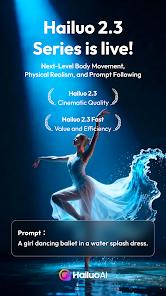
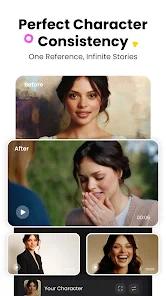
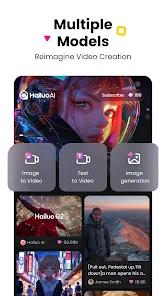

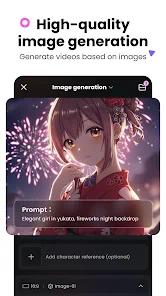
Hailuo AI, developed by MiniMax AI, has emerged as a formidable challenger in the generative video space, particularly in late 2024 and throughout 2025. The app specializes in high-fidelity, physics-aware video generation from text and image prompts. At its core, Hailuo AI utilizes a sophisticated diffusion transformer architecture that rivals OpenAI’s Sora and Kling AI in terms of temporal consistency and motion fluidity. Unlike earlier models that struggled with spatial logic, Hailuo manages to maintain the structural integrity of objects even during complex transformations.
Function Breakdown: The app’s primary function is its dual-mode 'Text-to-Video' and 'Image-to-Video' system. The text-to-video module is capable of interpreting highly descriptive prompts, translating abstract concepts into concrete visual sequences with cinematic lighting. For instance, prompting 'a cyberpunk neon city reflecting in a rain-slicked pavement as a hovercar glides past' results in a clip where the reflections accurately distort according to the water's surface tension. The Image-to-Video feature is equally impressive, allowing users to upload a character or landscape and animate it with specific motion brushes. You can designate areas of an image to move while keeping others static, which is essential for professional-grade cinemagraphs.
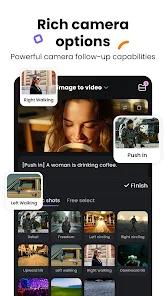
Deep Insights: What truly sets Hailuo AI apart is its handling of human kinetics. While many AI tools produce 'uncanny valley' effects where limbs move unnaturally, Hailuo models follow realistic joint constraints and muscle movement. This makes it an ideal tool for storyboarding and independent filmmaking. In the current market, Hailuo positions itself as a 'high-end' creative assistant. It doesn't just generate a random video; it provides a 'Motion Control' suite where users can adjust camera angles, focal lengths, and even the 'chaos' level of the generation. By 2026, the app has integrated sound effects generation that automatically syncs with the visual actions, such as footsteps or rustling leaves, providing a near-complete production environment in the palm of your hand.
Industry Comparison: When placed side-by-side with Kling AI, Hailuo often feels more polished in its texture rendering, particularly skin and fabric. Kling might offer longer continuous clips (up to 10 seconds), but Hailuo’s 6-second segments are generally more consistent and require fewer re-rolls. Compared to Runway Gen-3, Hailuo offers a more streamlined mobile experience, making it the preferred choice for mobile-first content creators on platforms like X and TikTok. It effectively bridges the gap between high-end professional software and accessible consumer apps, proving that quality doesn't have to be sacrificed for speed.
Pros
Superior physics engine and motion consistency
User-friendly interface for non-technical users
High-fidelity facial rendering and expressions
Integrated AI sound effect generation
Cons
Limited to 6-second bursts in standard mode
Subscription model is more expensive than generic rivals
Requires significant processing time for high-def renders
FAQs
Commercial rights are typically reserved for Pro and Enterprise subscribers.
Typically 2-4 minutes depending on the complexity and resolution settings.
Yes, it offers a dedicated 'AI Upscale' feature for 4K exports in the premium tier.
Hot Reviews
Commercial rights are typically reserved for Pro and Enterprise subscribers.
Typically 2-4 minutes depending on the complexity and resolution settings.
Yes, it offers a dedicated 'AI Upscale' feature for 4K exports in the premium tier.