Leonardo.Ai - Image Generator


Overview
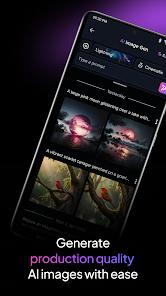
Leonardo.Ai has established itself as one of the premier platforms for AI-driven asset generation, moving far beyond simple image creation into a full-scale creative suite for professionals. Since its inception, it has focused on 'Creator Control,' offering a toolset that provides significantly more granular power than the 'black box' approach of competitors like Midjourney. The mobile app brings this desktop-level power to Android, optimized for a touch-based workflow.
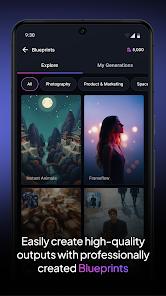
Function Breakdown: The app's architecture is built around several specialized models, including the flagship 'Leonardo Phoenix'—which excels at prompt adherence and coherent text within images. Key features include 'AI Canvas' (for outpainting and inpainting), 'Motion' (turning static images into 4-second videos), and 'Real-time Canvas' (where the AI generates as you doodle). A significant feature for professional creators is the 'Training' module, where users can upload their own images to create a custom LoRA (Low-Rank Adaptation). This allows a brand or game developer to maintain a consistent style, character, or asset aesthetic across thousands of generations.
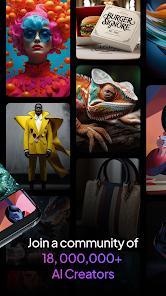
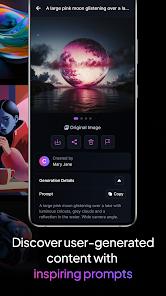
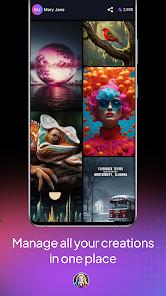
Deep Insights: Leonardo.Ai's 'Production-Ready' philosophy is its defining characteristic. It is designed for game development, marketing assets, and concept art. Its 'Prompt Magic' and 'Negative Prompting' features allow for a level of surgical precision that is rare on mobile. By mid-2025, Leonardo integrated multi-modal capabilities, allowing users to guide the AI with both a text prompt and a structural sketch simultaneously. It represents the shift of AI from a casual toy to a professional design tool. Its community focus is also a major draw, with a 'Community Feed' that allows users to 'remix' prompts and settings from the world's top AI artists, fostering a collaborative ecosystem.
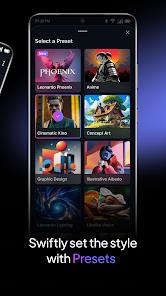
Competitive Edge: Compared to the DALL-E 3 integration in ChatGPT, Leonardo offers vastly more aesthetic variety and professional controls. Users can choose from dozens of community-finetuned models ranging from '3D Render' to 'Vintage Photography.' It effectively occupies the middle ground between the accessibility of Canva and the technical complexity of Stable Diffusion, providing a 'Prosumer' platform that satisfies both hobbyists and commercial designers.
Pros & Cons
Unmatched variety of fine-tuned models
Exceptional control via negative prompts and guidance scales
Powerful 'Real-time Gen' features for instant ideation
Generous daily free credit allowance
- ✕
Steeper learning curve than basic AI generators
- ✕
The mobile interface is dense and can feel cluttered
- ✕
Advanced 'Train' features consume a lot of tokens
Download
 Get it on Google Play
  Get it on App Store
 FAQs
Is Leonardo.Ai free?
It uses a freemium model with 150 daily tokens that reset every 24 hours.
Can I create my own model on the mobile app?
Yes, you can upload training images directly from your gallery to create custom models.
Do I own the images I create?
Paid plans include full commercial rights to all generated content.
Hot Reviews
I use this for everything—logos, D&D characters, even textures for my indie game. The consistency is incredible.
I'm amazed that I can do full outpainting and character training on my Android. No other app comes close.