
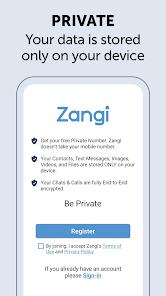

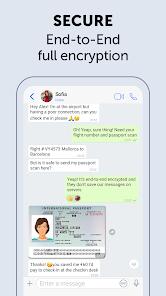
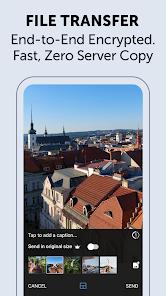
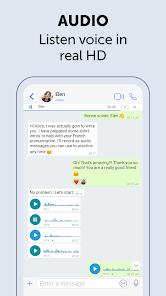
Zangi Private Messenger has become the gold standard for high-security, low-footprint communication in 2026. As mainstream apps like WhatsApp face increasing scrutiny over metadata and data-sharing, Zangi's 'Serverless' philosophy has attracted millions of privacy-conscious users. Zangi does not store your messages on its servers; everything is encrypted end-to-end and stored only on the sender’s and receiver’s devices. This eliminates the 'central honeypot' risk that hackers often target. Even more uniquely, Zangi does not require a phone number or email to sign up, allowing for complete anonymity—a feature that is becoming increasingly rare in 2026.
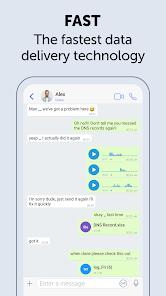
Technically, Zangi’s standout feature is its 'Low Data Usage' protocol. In an era where 5G is the norm, Zangi focuses on the millions of people in areas with poor infrastructure. It uses a proprietary codec that can facilitate high-definition voice and video calls even on 2G or unstable satellite connections. Zangi is often seen as more 'lightweight.' It offers better performance in 'hostile' network environments. For the 2026 user, it also includes 'Incognito Mode' for calls, ensuring that no trace of the communication exists on the device’s standard call log. It is a tool for journalists, activists, and anyone who views privacy as a fundamental human right rather than a luxury.
Pros
True serverless architecture for maximum privacy
No personal identification (phone/email) required
Superior performance on low-bandwidth/2G connections
Cons
If you lose your device, your message history is unrecoverable
User base is smaller than WhatsApp/Telegram
The interface is very functional and lacks 'flashy' social features
FAQs
You share your unique Zangi ID or a QR code to connect with others.
Yes, Zangi to Zangi calls are free. They only use data, and very little of it.
Yes, there is a desktop client that syncs directly with your phone using a secure peer-to-peer connection.
Hot Reviews
You share your unique Zangi ID or a QR code to connect with others.
Yes, Zangi to Zangi calls are free. They only use data, and very little of it.
Yes, there is a desktop client that syncs directly with your phone using a secure peer-to-peer connection.