
Briar
Overview
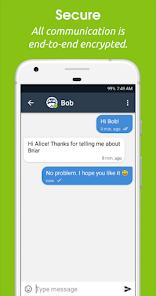
The Briar app represents a specialized, serverless approach to digital communication. Designed to meet the security requirements of activists, independent journalists, and civil rights groups operating in highly monitored environments, the software completely eliminates centralized infrastructure. The platform establishes a decentralized peer-to-peer (P2P) network where client databases synchronize directly with one another. When active internet connections are available, the application routes all traffic through the Tor network. It sets up end-to-end encrypted Tor v3 onion services for each client, effectively masking IP addresses and keeping social relationship graphs secure.
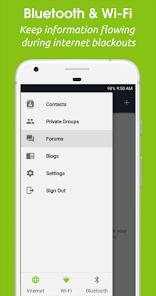
The primary technical innovation of the platform is its multi-transport mesh synchronization system. In regions experiencing localized cellular blackouts or active state-sponsored internet censorship, the software shifts from Tor-based routing to local physical channels. Using the device's built-in adapters, it establishes ad-hoc mesh networks over Bluetooth or local Wi-Fi. When absolute physical isolation occurs, it can even transfer encrypted messages via removable memory cards. This transport-agnostic architecture relies on the Bramble Handshake and Bramble Transport protocols, which enforce forward secrecy across all communication channels. This ensures that even if a future private key is compromised, previous session logs remain secure.
This peer-to-peer model places the responsibility of data availability entirely on the client endpoints. Because there are no intermediate cloud servers to queue messages, a sender and a recipient must be online at the same time to exchange data. To address this, developers created the Briar Mailbox—an auxiliary, low-power app that runs on a secondary device. This mailbox acts as a localized, offline store-and-forward proxy. It safely buffers encrypted messages and delivers them once the primary target device reconnects to the local network.
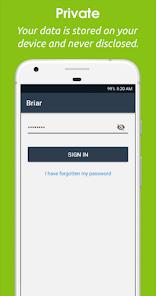
The software's strict adherence to security principles is evident in how it manages local storage. All local databases, contact profiles, and chat logs are fully encrypted on-device using SQLCipher. Additionally, the platform disables system-level screenshotting and screen recording by default, protecting the interface from local malware or physical surveillance. Finding contacts is also designed to prevent remote discovery; users must either scan physical QR codes in person or exchange unique Bramble links over external secure channels, preventing unauthorized surveillance of contact lists.
Pros & Cons
Complete Metadata Shielding: Eliminates central servers entirely, keeping metadata, contact lists, and message databases strictly on the user's local device.
Resilient Mesh Offline Synchronization: Seamlessly switches to Bluetooth or local Wi-Fi mesh connections to maintain communication during cellular blackouts.
Integrated Onion Routing: Employs Tor v3 onion services to hide the user's IP address, physical location, and network relationships.
No-Identify Signup Protocol: Requires zero personal information, phone numbers, or email addresses for account creation, ensuring complete anonymity.
Independently Audited Codebase: The entire client is open-source, professionally audited, and supports reproducible builds, allowing users to verify that the binaries match the public source code.
- ✕
Simultaneous Online Requirement: Messages cannot be delivered asynchronously unless both clients are active online at the same time or use a physical Briar Mailbox helper.
- ✕
Platform Limitation: The application is developed exclusively for the Android ecosystem, preventing cross-platform use with iOS devices.
- ✕
High Battery Consumption: Maintaining persistent peer connections and running background Tor routing processes significantly increases device battery drain.
- ✕
No Voice or Video Support: Lacks voice calling, video conferencing, and general multimedia streaming systems, limiting communication to text and compressed image sharing.
Download
 Get it on Google Play
  Get it on App Store
 FAQs
How does the application synchronize messages when the internet is unavailable?
The application utilizes the device's Bluetooth and Wi-Fi adapters to establish localized, ad-hoc peer networks. Messages are securely stored in the local database and automatically synced when a peer comes within physical transmission range.
Why are screenshots disabled across the interface by default?
To prevent unauthorized local data leakage and malware-based screen scraping, the software blocks the Android system from capturing screenshots or recording screens within the app.
Can an account be recovered if the password is lost?
No. Because the platform uses a zero-knowledge model and stores no data on central servers, there are no administrative backdoors or password recovery links. Losing the password results in permanent account and data loss.
What is the function of the Briar Mailbox?
The Briar Mailbox is an auxiliary application that can be installed on a secondary Android device. It acts as a private, low-power, serverless relay that receives and buffers encrypted messages when the primary device is offline.
How are contacts added securely within the platform?
Contacts are ideally added face-to-face by scanning encrypted QR codes generated directly on-screen. Alternatively, users can exchange unique Bramble-encoded links via external secure channels, though physical QR scanning remains the most secure method against man-in-the-middle exploits.
Hot Reviews
Users report high satisfaction with the app's offline Bluetooth sync capabilities, particularly on cruise ships and in remote areas lacking cellular service.
Active testers have noted that when both Wi-Fi and Bluetooth are enabled, the application occasionally fails to transition between the two connection modes automatically if one link fails.
Users express frustration over the inability to send raw document files, noting that the image compression algorithm degrades shared photo quality.