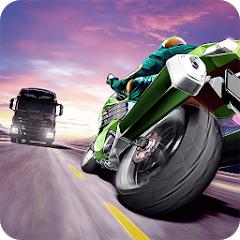
Traffic Rider
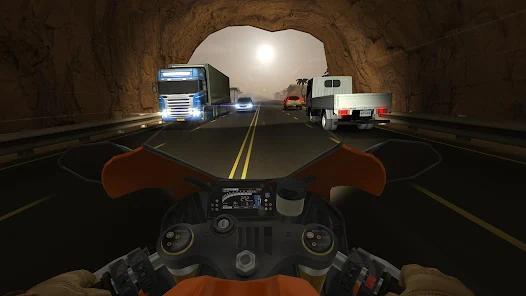
Traffic Rider earns its place in any mobile gaming rotation on the strength of its first-person cockpit view and genuinely impressive audio craft — but it's a highway game through and through, and the late-career grind will eventually ask whether you'd rather wait or pay.
- Mobile gamers who want an offline-first, adrenaline-soaked arcade racer with no energy bars, no timers, and no interruptions
- Players who respond to sensory immersion — authentic engine recordings and a cockpit perspective that make a near-miss at 250 km/h feel genuinely alarming
- Anyone who craves circuit lap racing, off-road terrain, or head-to-head multiplayer — Traffic Rider is a single highway and a solo experience
- Players who stall at late-game difficulty spikes without grinding for currency: the gap between free-to-earn bikes and the top superbikes nudges toward real spending
Overview
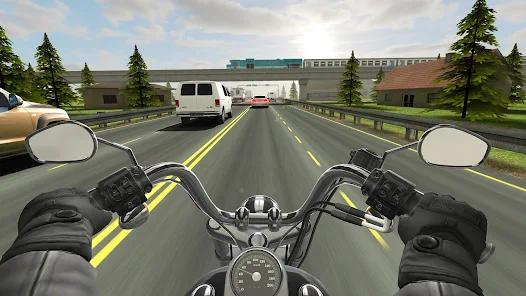
Traffic Rider figured out something most mobile racing games haven’t: the sensation of speed is more compelling than the illusion of racing. Put the camera behind the handlebars, record real engine sounds from real bikes, and suddenly weaving through a wall of commuter traffic at 200 km/h becomes an experience that’s fundamentally different from anything a top-down or third-person racing game can deliver. That insight — simple, obvious in retrospect — is why SK Games has accumulated more than 500 million installs and over 8 million ratings at a 4.5-star average. It didn’t pile on features before the core sensation was worth chasing. Most mobile games work in the opposite order.
We’re flagging the scale upfront because it matters. Traffic Rider isn’t a cult hit; it’s a mass-market phenomenon, and the question worth asking about any game at that size is whether the polish matches the numbers or whether the install count is a relic of an era before something better came along. Based on everything the signals tell us, the core experience holds.
The cockpit is the product
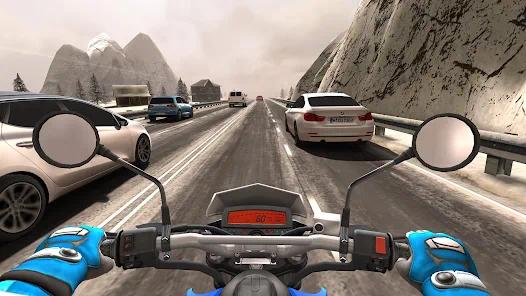
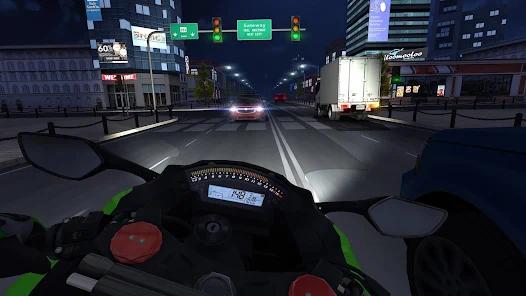
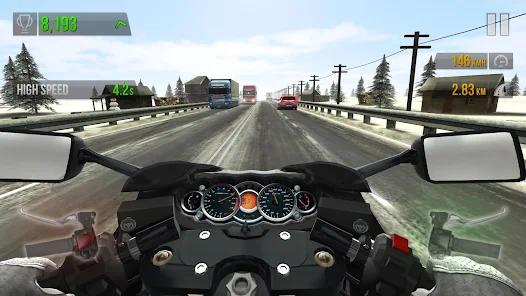
The first-person perspective isn’t a stylistic choice bolted on as a differentiator — it’s the entire design premise, and every mechanic flows from it. When you’re threading a gap between a lorry and a sedan at 180 km/h and the mirror fills your peripheral view, the game’s close-overtake bonus system rewards you for that risk with extra cash and points. The reward feels earned because you felt the near-miss from inside it. The signal that surfaces most often in user reviews isn’t about graphics benchmarks or feature breadth; it’s visceral: the 250 km/h screen blur, the way the engine note climbs through the rev range. One reviewer described it as making every near-miss “feel terrifyingly real.” That’s the game doing its job.
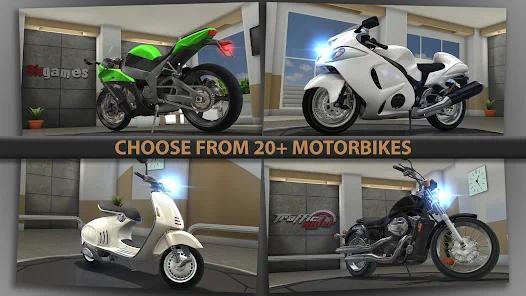
The audio design deserves its own paragraph, because it’s genuinely unusual for a mobile title. SK Games recorded real motorcycle engines for each of the 34 bikes in the roster — a detail that sounds like marketing copy until you notice that reviewers call it out independently, without prompting, as the best motorcycle audio they’ve heard on any phone game. Each bike sounds distinct. The day/night transition and weather system (rain and snow conditions are both present) shift the visual register without layering complexity onto the controls. These are quality decisions that tend to disappear from a mobile game’s budget first. That they’re here, in a free-to-play title, says something about where the developer put its effort.
Modes, missions, and the career structure
Traffic Rider isn’t just an endless runner in a bike jacket. The career mode anchors the experience with over 90 missions that require specific objectives rather than simply “survive as long as possible.” Time-sensitive passages, rush-hour density targets, sustained high-speed runs — the variety gives you actual goals to chase and a reason to upgrade beyond novelty. Four modes exist in total: Career, Endless, Time Trial, and Free Ride. The last is exactly what it sounds like: no objectives, just a highway and whatever bike you’ve unlocked, which makes a functional decompression mode the game doesn’t bother advertising as one.
The close-overtake system is worth examining as design thinking. The game rewards risky behavior mechanically: bonus cash for driving above 100 km/h, bonus cash for close passes, bonus cash for riding the wrong-way on a two-way section, bonus cash for wheelies. That’s a system teaching you to play aggressively instead of safely — which is the opposite of how most games handle high-speed action. Traffic Rider hands you a financial reason to take the narrow gap you could have avoided.
Controls are tilt-and-touch, described as precise enough to execute close-quarters weaving reliably. The game is also fully offline, which on a mobile racing title is worth naming explicitly: no data connection required, no cloud syncing, no “come back when your fuel refills.” That last point is where the next section begins.
The monetization: genuinely fair, until it isn’t
The “No Timers, No Fuel” philosophy is the thing real users call out most enthusiastically. Traffic Rider doesn’t stop you from playing. You can work through career mode for hours and the game will not ask you to watch an ad to continue or wait for an energy bar to recharge. For a free-to-play mobile game, that’s a meaningful departure from genre defaults, and reviewers notice it: “It is so rare to find a game that lets you play for as long as you want without asking for ‘fuel’ or making you wait for a timer.”
To be clear: the signals don’t flag intrusive advertising as a recurring problem. The monetization is concentrated in the vehicle roster. Bikes are unlocked through career progress or purchased with in-game cash — but the top-tier superbikes carry a price in the in-game economy that the signals describe as “quite high.” That’s where the free-to-play tension lives. Later career missions tighten their time limits to a degree that makes the gap between mid-tier bikes and the superbike ceiling functionally significant. You can grind — the signals specifically describe this as “a slow grind for in-game currency” — or you can spend. That nudge is real, and the “no energy timer” generosity doesn’t exist in isolation from it.
The practical effect: the first several hours of career progression feel genuinely free. The wall comes later and gradually enough that by the time you hit it, you’re already invested. That’s the design. Know it going in.
What real users report — and where they’re frustrated
The review themes from the eight million-plus ratings divide into two consistent camps. The enthusiasts are talking about sensation: the speed, the audio, the way the cockpit creates genuine adrenaline. One recurring note is the chrome-and-light visual detail on the bikes themselves — reviewers mention it unprompted, which suggests it lands. These players are there for the feel, and the feel delivers.
The frustrations are structural rather than technical. Repetition surfaces: the highway is a highway, and after 90 career missions plus unlimited Endless mode, route variety is minimal. Late-career difficulty spikes register as punishing for players who’ve hit the in-game currency ceiling without spending. And for anyone who wants something beyond solo highway runs — circuit tracks, competitive multiplayer, time-attack leaderboards — Traffic Rider simply doesn’t go there and makes no pretense of going there.
How it sits in the mobile racing genre
Mobile racing broadly divides into two forms: the physics-based circuit racers that lean on lap times and opponent AI, and the endless-road survival runners. Traffic Rider is firmly in the second camp, and it’s the most complete version of that form factor that the signals support. It doesn’t try to compete with circuit racers on their terms. What it does — the first-person sensory experience, structured career progression, authentic audio, offline reliability — it does at a level the genre rarely reaches on mobile.
If you’ve bounced off endless runners because they felt mechanically thin, Traffic Rider is worth revisiting. The cockpit perspective and close-pass bonus mechanic add active engagement that purely top-down runners don’t deliver. If you’re a circuit racer who needs lap times, opponents, and corners, this game isn’t the answer and was never trying to be.
A note on version and freshness
Our signals have Traffic Rider at version 2.11 without a confirmed update date. At 500 million installs and a 4.5-star average across more than eight million reviews, the product is clearly not abandoned — but we can’t confirm from current signals whether the developer is adding new content on a regular cadence. What’s there is substantial enough to occupy you for a long time. Whether there’s active expansion behind it, we can’t say.
The verdict
Traffic Rider is the rare free-to-play mobile game where the core experience — not the monetization loop, not the social hooks, not the energy-bar anxiety — is the reason to be there. The cockpit perspective and real-engine audio create something that goes beyond “a mobile game that works fine”; they create a sensation that stays with you. The 90-plus career missions give you something to work toward. Offline capability and the no-energy-timer design make it as pick-up-and-put-down as mobile racing gets.
The honest limits are these: it’s a highway, it’s solo, and late-career progression will eventually apply financial pressure. None of those are hidden — they’re the shape of the game from the first session. Go in knowing what it is, and Traffic Rider delivers exactly what it promises.
How We Evaluate
We judge every app on what it actually delivers, how honest the pitch is, and where real users hit friction. For Traffic Rider that meant working through its modes and progression structure, reading across the Play Store's eight million-plus reviews for recurring themes, and examining its monetization against the in-game economy's actual design. We don't claim hands-on device testing; our findings are grounded in documented signals, developer descriptions, and real user feedback.
Pros & Cons
Immersive first-person camera perspective provides a unique sense of speed and vulnerability that is unmatched in the motorcycle genre.
Authentic audio design, featuring engine sounds recorded from real motorcycles, significantly enhances the realism of the ride.
Extensive career mode with 90+ missions provides a clear path of progression and long-term goals for players.
Dynamic environmental conditions, including a day/night cycle and weather effects, keep the highway tracks visually engaging.
A "No Timers, No Fuel" model ensures that gameplay is not interrupted by restrictive energy systems found in many freemium games.
Intuitive tilt and touch controls provide high precision for weaving through dense highway traffic at high speeds.
The game is highly optimized for performance, offering high-fidelity graphics that run smoothly on a vast range of Android devices.
- ✕
Late-game missions can become repetitively difficult, occasionally feeling like a slow grind for in-game currency.
- ✕
The cost of top-tier superbikes is quite high, which may push some users toward in-app purchases to maintain progression.
- ✕
The endless highway format may lack the variety sought by players who prefer circuit racing or off-road environments.
Download


FAQs
How do I earn bonus cash in Traffic Rider?
Bonuses are awarded for driving over 100 km/h, performing close overtakes, driving in the opposite direction on two-way roads, and doing wheelies.
What are the different game modes?
Beyond Career mode, players can choose Endless, Time Trial, and Free Ride for more relaxed or specific challenges.
Are the bike sounds real?
Yes, the developer recorded real motorcycle engines to ensure each bike in the 34-vehicle roster sounds distinct and authentic.
Can I play Traffic Rider without an internet connection?
Yes, Traffic Rider is fully functional offline, making it a reliable choice for mobile use without data.
How do I unlock new motorcycles?
Bikes are unlocked through Career mode progress or by purchasing them with cash earned during gameplay.
Is there a way to customize my rider?
Players can change the color of their motorcycle and even select different styles and colors of gloves for the rider.
Hot Reviews
The first-person view makes every near-miss feel terrifyingly real. When you’re at 250 km/h, the screen blur and the engine roar really get your adrenaline pumping.
It is so rare to find a game that lets you play for as long as you want without asking for "fuel" or making you wait for a timer. It’s pure racing fun.
The way the light reflects off the chrome of the bikes and the realistic sounds of the engines make this the best motorcycle game on the store by far.