
US Dept. of Justice NSOPW App
Overview
The administrative and technical architecture of the United States Department of Justice National Sex Offender Public Website (NSOPW) mobile application represents a crucial government-to-citizen safety initiative. Developed through a federal grant administered by the Office of Sex Offender Sentencing, Monitoring, Apprehending, Registering, and Tracking (SMART) under the Office of Justice Programs, this utility serves as an official extension of the Dru Sjodin National Sex Offender Public Website. The primary mandate of the application is to empower public safety awareness by granting direct, decentralized access to the unified registry databases of all fifty states, US territories, Indian tribes, and the District of Columbia.
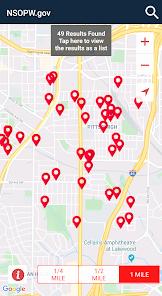
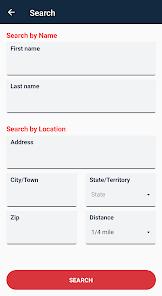
At its operational core, the application leverages the mobile device’s Global Positioning System (GPS) telemetry to establish spatial query parameters. Users can define search boundaries using concentric radii of 0.25, 0.50, or 1.00 mile. This geospatial coordinate package is queried against the integrated national index. Due to the federalist design of public registries, geographic query compatibility varies by jurisdiction. If a registering state or tribal authority restricts search capabilities based on raw latitude and longitude, the app uses a fallback algorithm that triggers a regional ZIP code query.
A key technical characteristic is the federal-state registry hand-off. The app is a query aggregator rather than a host database. When a user requests deeper case profiles, the app redirects them to the official website of the specific registering jurisdiction. This design choice poses interface challenges, as these legacy, state-run websites are often not optimized for modern mobile devices. It is free with zero ads and no subscription barriers.
Pros & Cons
Direct integration with official United States Department of Justice systems guarantees highly authoritative data sources.
Free service model with no in-app purchases, advertisements, or premium access walls.
Variable geographical search ranges allow users to perform localized analysis within 1/4, 1/2, or 1-mile radii.
Automated system transitions to ZIP code queries when local jurisdictions block geographic coordinate searches.
Comprehensive query support spans all US states, native territories, and the District of Columbia.
- ✕
Fragmented user experience caused by redirections to non-responsive, external state-level portal websites.
- ✕
Absence of proactive alert features, such as background geofencing notifications when new records are registered.
- ✕
High susceptibility to search timeouts and database latency errors during narrow-radius scans.
- ✕
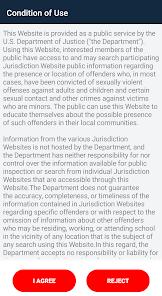
Strict liability limitations prevent users from legally relying on the realtime accuracy of dynamic map pins.
Download
 Get it on Google Play
  Get it on App Store
 FAQs
How often is the data within the application updated?
The frequency of data refreshes is determined by the individual registering jurisdictions (states, territories, and tribes) that upload their files to the national database. The app displays real-time results from these registries, but latency may exist depending on how quickly local agencies update their local systems.
Why does the map visualization sometimes fail to display exact pin locations?
This occurs when the jurisdiction responsible for the registry limits geographic coordinate searches. In these areas, the app defaults to a ZIP code list view rather than plotting coordinates on a dynamic map.
Are there any user tracking or data monetization risks associated with the app?
No. The developer declares that no data is shared with third parties. While location telemetry is processed to handle local queries, this information is encrypted in transit and not used for advertising or profiling.
What should be done if the app times out during a search?
Database timeouts are common when server loads are high or when searching densely populated areas. Broadening the search radius to one mile or manually searching by name can help bypass localized coordinate query limits.
Is a user account or personal login registration required to run searches?
No, the application does not require any personal user registration, email linkages, or account setups. It operates as an open-access public search tool to maximize accessibility and protect user privacy.
Hot Reviews
Users report that while the mapping feature is helpful in theory, it frequently fails to pinpoint exact registry addresses in practice. This often limits output to list-based views or ZIP code lookups, which reduces the usability of the map during travel.
Reviewers point out that viewing detailed record profiles requires navigating multiple external hyperlinks. Because these local state websites are not mobile-friendly, the back-and-forth process is slow and inefficient.
Many users note that the tool is strictly reactive. Without background geofencing or automatic residential registry updates, users must manually run scans to stay informed.