
PictureThis - Plant Identifier
PictureThis is the strongest plant-care app on Android — and it makes sure you know it, nudging you toward a subscription from the first session. The identification engine is legitimately impressive, but the free tier is so limited that treating this as anything other than a paid product sets you up for frustration.
- Committed home gardeners and plant parents who'll pay for a subscription and want a single app for species ID, disease diagnosis, and watering reminders
- Pet owners and parents who need reliable toxic-plant warnings before bringing unfamiliar greenery into the home
- Anyone expecting meaningful free functionality — the free tier is a conversion funnel, not a usable product in its own right
- Privacy-minded users uncomfortable with broad data collection: PictureThis gathers and shares personal, financial, and location identifiers with third-party networks


Overview
PictureThis is not a casual curiosity tool for the occasional “what’s this weed?” question — there are free apps for that. It’s a full-stack plant-care platform: one that aims to identify your houseplant, diagnose its disease from a photograph, remind you when to water it, gauge whether it’s getting enough light, and flag instantly if it poses a risk to your pets or children. That’s an ambitious mandate, and the core technology earns it. The question every prospective user needs to answer before downloading is whether they intend to pay for access to that depth — because the free tier, by consistent user accounts, functions more as a product demonstration than a finished product.
What roughly a decade of training buys you
The app began life in China in 2015 as XingSe before Glority Global Group launched it globally as PictureThis in 2017. That roughly decade-long development runway matters. The model has been trained on millions of daily queries and now covers more than 400,000 species, with the developer reporting up to 98% identification accuracy via cloud-based visual analysis. We can’t independently verify that figure, but the consistency of reviewer accounts is telling: beginners correctly identifying obscure houseplants on the first snap, users singling out the Latin pronunciation audio as a mark of genuine taxonomic depth — the kind of care most ID apps skip — and care history logs described as “highly useful for beginners.”
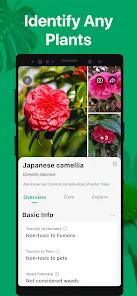
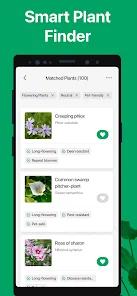
The core identification interaction is fast. Point the camera at a plant, tap the shutter, receive results in seconds. What you get isn’t just a species label: PictureThis serves a complete profile including common and scientific names and species-specific care requirements. The depth is what separates it from apps that return a name and stop there.
The care toolkit: what it is and what it does
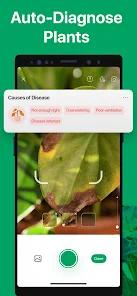
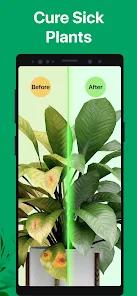
The disease-diagnosis tool extends the value further. Upload a photo of yellowing leaves, spotted stems, or wilting growth, and the app generates an automated health assessment alongside a step-by-step treatment plan. Multiple reviewer accounts describe what can fairly be called plant-rescue moments — correct diagnoses that identified a problem and guided a recovery for a plant that appeared to be dying. We’re relying on user accounts, not our own testing, but the pattern repeats with enough regularity and specificity to carry real weight.
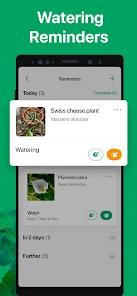
Beyond identification, the app bundles a digital light meter that reads ambient conditions via the phone’s sensor to tell you whether a houseplant is receiving adequate sun, smart watering and fertilization reminders keyed to each plant’s individual care schedule, weed management guidance, and toxic-plant alerts that flag when a scanned species is harmful to dogs, cats, or young children.
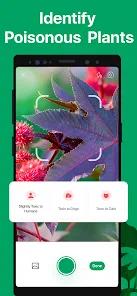
That last feature carries genuine practical urgency: for households with animals or toddlers, being able to photograph an unfamiliar gift plant and get a toxicity assessment in seconds justifies a download before you’ve touched anything else in the app.
The paywall reality
Here is where PictureThis becomes complicated to recommend without conditions.
Nearly every feature beyond the bare identification snap sits behind a subscription. Expert botanist consultations — described as a 24/7 service — are premium-only. Many advanced care tools, detailed disease analysis, and robust notification scheduling require an active paid plan. The reviewer signal on this is consistent and direct: users describe “frequent subscription screens” and an interface that “can feel pushy for those wanting basic features.” That’s a diplomatic framing for what amounts to an aggressive conversion funnel embedded in the core navigation.
The practical shape of it: you can point the camera, get a species name, and read a basic profile for free. What you cannot reliably access without paying is the full disease-treatment depth, expert consultation, and the comprehensive reminders system that most of the app’s promotional material leads with. The free tier is designed to show you why you should subscribe, not to be useful on its own terms.
This matters most if you’re downloading on the strength of a friend’s recommendation without understanding the cost structure. PictureThis is effectively a subscription product. If you approach it as one — making a deliberate choice to pay for what is genuinely a capable tool — the experience tracks with the rating. If you expect a generous free experience, you’ll hit walls quickly and they’ll arrive early. The signals don’t include the current subscription price, so we won’t speculate on a figure that may have changed; but the nature and frequency of the gating is well-documented across the review pool.
The data question
There’s a second concern that PictureThis’s own FAQ does not evade: the app collects and may share personal, financial, and location data with third-party networks. Background synchronization permissions — required for the reminder and alert system — carry real battery costs on lower-end devices, where persistent background processes can meaningfully affect daily battery life.
For most committed users, this is a trade-off they’ll accept. But apps like Pl@ntNet and iNaturalist are built around biodiversity documentation and community contribution, with a philosophy that points away from commercial data aggregation — a meaningful difference for anyone who compares them. If data privacy factors into your app decisions, know what you’re agreeing to before you tap Allow.
What real users report
The 758,000-review pool for PictureThis sorts into three recognizable groups, and the distribution is instructive.
The largest and most enthusiastic cohort comprises committed plant people who have built the app into their daily care routines. They praise the identification depth, the Latin pronunciation audio, the care history logs, and the diagnostic tool with the kind of specific, experience-grounded enthusiasm that earns a 4.6-star average and sustains a 50M-download install base. These are users who have paid for the subscription and found it proportionate to what they get in return.
The second group describes diagnostic success stories with real emotional stakes: plants brought back from visible decline, correct identifications of diseases that might otherwise have been misdiagnosed, treatment plans that worked as described. These accounts are specific enough to suggest the disease engine is reliable for common conditions, though how it handles rare or unusual plant diseases at scale is something we cannot assess from signals alone.
The third group — a consistent minority — documents the subscription friction: an interface that prompts conversion frequently, features that gate earlier than users expect, and a sense of using a funnel rather than a finished product. It’s the most useful signal for anyone considering the app who hasn’t yet decided whether to pay.
How it compares to the alternatives
The meaningful free alternatives are Pl@ntNet, iNaturalist, and Google Lens.
Pl@ntNet is genuinely capable at identifying wild and garden plants, free to use, and purpose-built for scientific species documentation rather than care management. It does not do disease diagnosis, care scheduling, or toxicity alerts. iNaturalist skews even further toward community biodiversity observation; it’s a research and citizen-science platform, not a houseplant tool. Google Lens identifies plants competently as a byproduct of general visual search — adequate for a quick label, and nothing more.
If your question is purely “what plant is this?” a free option will serve you without asking for a subscription or routing location data to ad networks. If your question is “what’s wrong with this plant, how do I treat it, when should I water it next, and is it safe for my cat?” — PictureThis is the only Android option that answers all four in a single interface. That’s the honest case for its premium pricing, and it’s a real one.
Recency note
Version 5.28.0 landed on June 9, 2026 — three weeks before this review. For an app processing millions of daily queries against a 400,000-species database, active maintenance isn’t optional; a stale model starts missing things. Glority’s update cadence suggests a platform they’re actively investing in, not one coasting on an early-mover advantage.
The verdict
PictureThis is the best plant-care app available on Android, and it’s not especially close. The identification engine is deep and well-trained, the disease-diagnosis tool has genuine real-world utility, and the toxic-plant alert system belongs on any plant-forward household’s phone regardless of what else the app offers. The 4.6-star average across nearly 760,000 reviews is not hype; it reflects what the app actually delivers to users who have committed to it.
What it also delivers, to users who haven’t committed, is a persistent reminder that the version they actually want costs money — and, running in the background, telemetry that travels further than some users will be comfortable with. Those aren’t oversights. They’re the shape of a commercial product with a clear business model, and the honest thing to say is that they matter more to some users than others.
If you’re a home gardener willing to pay for a serious care tool, or a pet owner who needs reliable toxic-plant identification, this is the obvious choice on Android. If you want a free plant identifier with a lighter data footprint, the alternatives are good enough for the basics. Know which question you’re actually asking, and PictureThis will give you a clear answer about whether it’s the right app for you.
How We Evaluate
We evaluate every app on what it actually delivers, how honestly the pitch matches the experience, and where real users hit friction. For PictureThis, that means cross-referencing the published feature set with Play Store reviewer accounts — covering identification accuracy, the care tools, and the subscription model — weighted against 758,000 ratings and the developer's own FAQ answers on data collection. We did not conduct hands-on device testing.
Pros & Cons
High Identification Accuracy: Identifies over 400,000 species with a 98% success rate using advanced visual analysis.
Automated Disease Diagnosis: Offers quick health assessments and step-by-step recovery plans for sick plants.
Smart Care Reminders: Tracks watering, misting, and fertilization intervals, sending automatic alerts.
Built-in Light Meter: Uses device sensors to check if houseplants are receiving optimal sunlight.
Toxic Plant Warnings: Alerts users when a scanned plant is hazardous to dogs, cats, or children.
Botanical Wallpapers: Curates a daily selection of professional-grade plant wallpapers and visual assets.
- ✕
Aggressive Subscription Walls: Restricts many advanced tools, such as expert chat, behind premium paywalls.
- ✕
Broad Data Telemetry: Gathers and shares personal, device, and location identifiers with third-party networks.
- ✕
High Battery Consumption: Demands constant background permissions for notifications, which can affect battery life.
Download
 Get it on Google Play
  Get it on App Store
 FAQs
How accurate is the PictureThis plant identification engine?
The app uses cloud-based machine learning to identify over 400,000 species with up to 98% accuracy.
Can the app diagnose sick plants?
Yes. Users can take a photo of leaf spots or discoloration to receive an automated diagnosis and recovery plan.
What is the difference between PictureThis and scientific apps?
PictureThis is a commercial app focused on houseplant care, diagnostics, and alerts, whereas platforms like Pl@ntNet focus on documenting wild biodiversity.
Does the app collect personal information?
Yes, according to its privacy policy, it may collect and share personal, financial, and location data.
Where was this application developed?
The technology was originally developed in China as XingSe in 2015, before launch under Glority Global Group as PictureThis in 2017.
Hot Reviews
Users praise the app's detailed plant profiles, noting that features like Latin audio pronunciations and care history logs are highly useful for beginners.
Reviewers share success stories about using the auto-diagnose tool to save dying houseplants by following its treatment guidelines.
Many users complain about the app's frequent subscription screens, stating that the interface can feel pushy for those wanting basic features.