
I Am Monkey

Overview
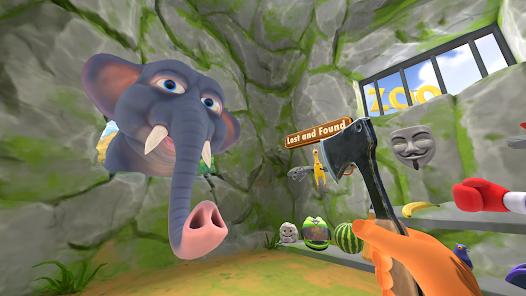
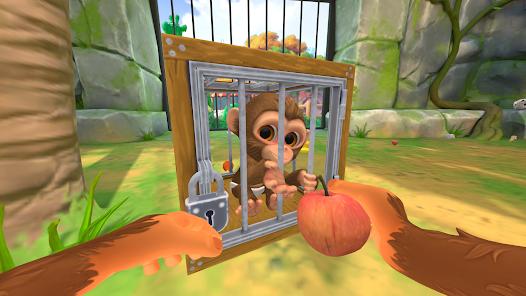
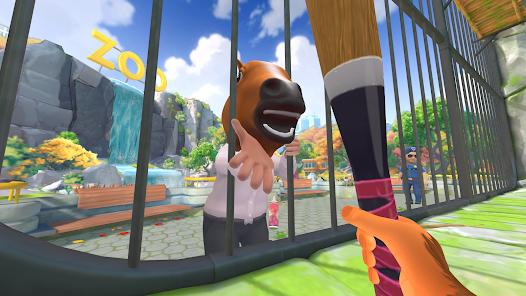
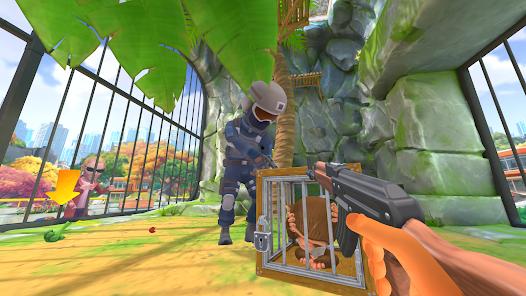
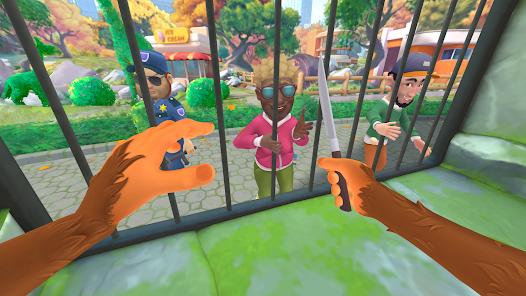
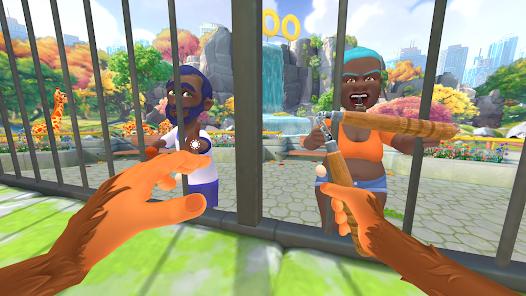
The application I Am Monkey is an intriguing adaptation of the VR experience that places the player inside the cage of a zoo monkey. The functional decomposition of this app centers on "enclosure dynamics"—the interaction between a captive animal and a rotating cast of human visitors. Unlike the bird or cat variants, I Am Monkey is more geographically constrained but offers higher "social density." Visitors arrive with distinct, programmed personalities: some are "gentle and generous," while others are "noisy, mocking, or aggressive". This creates a unique atmospheric tension. The player's choices—to charm, ignore, or resist these visitors—directly affect the environment of the cage and the reactions of the crowd.
Technically, the zoo space is a highly interactive playground. Players can grab, eat, or throw bananas, cameras, and random objects provided (or stolen) from visitors. The physics engine allows for complex interactions with the enclosure bars, the floor, and the gifts from visitors, making each session feel unique. Deep insights into the game's design suggest a subtext of social commentary on animal captivity. By allowing the player to "grab the visitors" or manipulate their belongings, the game shifts the power dynamic from the observer to the observed. This creates a "thought-provoking" sandbox where the player can choose to be a cute attraction or a chaotic menace.
With over 10 million downloads and a high ranking in the simulation category, I Am Monkey has established a significant user base in the US, Germany, and Canada. It requires Android 12.1+ for optimal performance, reflecting its reliance on more modern physics and rendering engines compared to older simulators. However, the most consistent user feedback is a critique of the "ad-to-gameplay" ratio. Players report that ads are required to unlock essential interactive items like cameras or weapons, and random ads frequently interrupt the simulation, sometimes every two minutes.
Pros & Cons
Unique Social Mechanics: The ability to gauge and react to different visitor personalities adds a layer of depth missing from standard simulators.
Dense Interactivity: While the map is smaller than I Am Bird, the concentration of interactable objects within the cage is exceptionally high.
Tactile First-Person Interaction: The mechanics for grabbing, eating, and throwing objects are well-translated from the VR version to mobile.
Humorous Environmental Storytelling: The varied reactions of visitors to the monkey's antics create organic, funny moments.
Active Version Maintenance: The developer ensures compatibility with the latest Android iterations (12.1+), providing a smooth experience on new devices.
- ✕
High Ad Saturation: Users report that nearly half of their playtime is spent watching advertisements, especially for item unlocks.
- ✕
Performance Latency: On mid-range devices, the game can experience lag or freezing during high-interaction sequences with large crowds.
- ✕
Restricted Environment: Players looking for exploration may find the single-cage setting repetitive compared to the city-wide scope of other simulators.
Download


FAQs
Can the monkey escape the cage in I Am Monkey?
The core gameplay is centered on the interactions within the enclosure, though players can interact heavily with visitors through the bars.
What kind of objects can I interact with?
You can grab cameras, bananas, and other gifts from visitors, as well as interact with the enclosure’s infrastructure.
Is an internet connection required?
The game is categorized as "Offline," meaning the core simulation logic runs locally, though ads may require connectivity.
What are the visitor types?
Visitors are categorized by their behavior: gentle (givers), noisy (mockers), and aggressive (provokers).
How does the VR port handle controls?
On mobile, it uses a stylized perspective and touch gestures to mimic the tactile grabbing and throwing of the VR version.
What is the minimum Android version?
Optimal performance requires Android 12.1 or higher, as noted in recent technical specifications.
Hot Reviews
Dealing with different types of visitors is the best part. When someone is being mean and you throw something back at them, the physics and the crowd reaction are hilariously well-done.
The game concept is 5 stars, but the implementation is a 2. Having to watch an ad just to get a camera or a weapon to play with is very frustrating.
It really feels like you are looking out from behind the bars. The way you can grab objects and people makes it one of the more tactile sims on the store.
The game is very fun but it can get quite laggy when there are many visitors on screen at once. It needs a bit more optimization for mobile hardware.